

Canadian Dollar
CADCommodity-linked
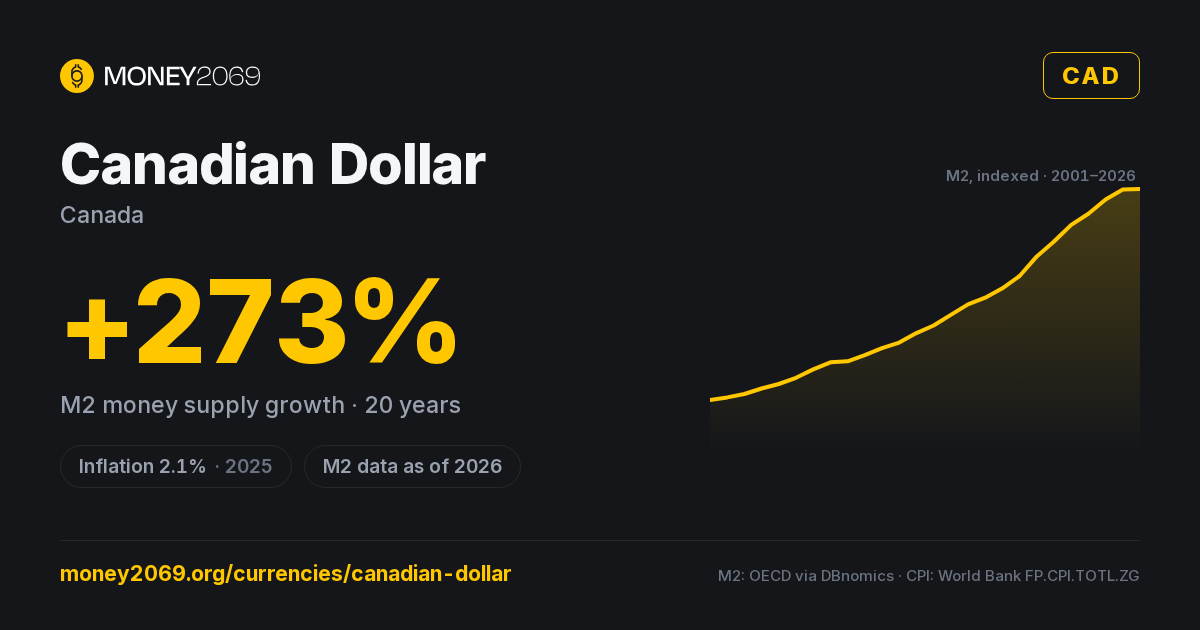
M2 money supply, indexed to 2001 = 100
Every line goes up — that’s the point. Angle of attack tells the story.
All series matched through 2024; some central-bank sources lag a year or two.
CAD highlighted against the top 10 reserve currencies — M2 broad money, indexed to 2001 = 100. CAD series: OECD via DBnomics, as of 2026.
Canadian Dollar M2 money supply
Broad money in CAD (cash + deposits + close substitutes), annual back to ~1960 via World Bank FM.LBL.BMNY.CN. Log scale auto-engages for hyperinflation outliers.
Canadian Dollar inflation history
Annual CPI YoY since 1966 — World Bank consumer price index for Canada. Inflation volatility is one of three inputs into the Money2069 sound-money score.

Purchasing power calculator
How much would your Canadian Dollar be worth today if you'd held it since…?
Calculation: cumulative product of (1 + CPI YoY) from the chosen year through 2025. Source: World Bank consumer price index (annual). Daily-refreshed.
Data sources & methodology
- FX (USD):
- Frankfurter / ECB · daily, Exchange Rate API fallback
- CPI YoY:
- World Bank FP.CPI.TOTL.ZG · annual
- M2 broad money:
- IMF / central-bank monthly · World Bank annual fallback (LCU)
- Market cap (USD):
- M2 / FX rate · daily
- 10-year M2 change:
- (M2 today / M2 10y ago) − 1
- M69 score:
- Weighted: CPI (50%), 10y M2 growth (40%), 1y FX stability (10%)
- Last fetched:
- 2026-09-13 02:00:02
- Country code (ISO 3166-1):
- CAN
Note: Commodity-linked
Raw data: /api/v1/currencies/current/CAD · Rates by Exchange Rate API
The Canadian Dollar from a sound-money lens
Commodity-linked, BoC inflation-targeting since 1991, ~80% lost since 1990.
The Canadian dollar is structurally tethered to commodity cycles — oil, lumber, metals, and agricultural exports drive roughly 40% of Canadian GDP and most of the loonie's daily volatility. When commodity prices rally, CAD strengthens; when they fall, CAD weakens. That makes the CAD/USD pair a useful proxy for the global commodity bid.
The Bank of Canada was an early adopter of inflation-targeting (1991) and has consistently delivered close to its 2% target — averaging 2.0% YoY over the past three decades. Cumulative inflation of 2% per year sounds modest until it compounds: a CAD 1990 dollar buys roughly CAD 0.51 of comparable goods today. M3 broad money has grown roughly 4x in real terms over the same period.
Canada's housing market is the elephant in any sound-money discussion: residential real estate hit 9x median income in Toronto and Vancouver at peak, fuelled by sustained low rates and a banking system that funnels household savings into mortgages. The BoC's 2022–2024 hiking cycle exposed how leveraged that household balance sheet had become.
For Money2069 purposes, the loonie is a workmanlike fiat: institutionally credible, low-volatility, with a central bank that tends to follow the Fed's lead by six months. Its purchasing power decay is steady and predictable rather than dramatic — which, for the past 30 years, has been enough to keep it on the second tier of reserve currencies.
Frequently asked questions
Who issues the Canadian Dollar?+
What is the inflation rate of the Canadian Dollar?+
Has the Canadian Dollar been debased?+
Is the Canadian Dollar sound money?+
How does the Canadian Dollar compare to gold or the US dollar?+
How often is this data updated?+
Compare with
More from Money2069
The Canadian Dollar inflates by policy. Money2069 runs on fixed rules — issuance targets 0%, purchasing power preserved by design, no central bank required.
