

Chinese Yuan
CNYManaged float; CIPS settlement
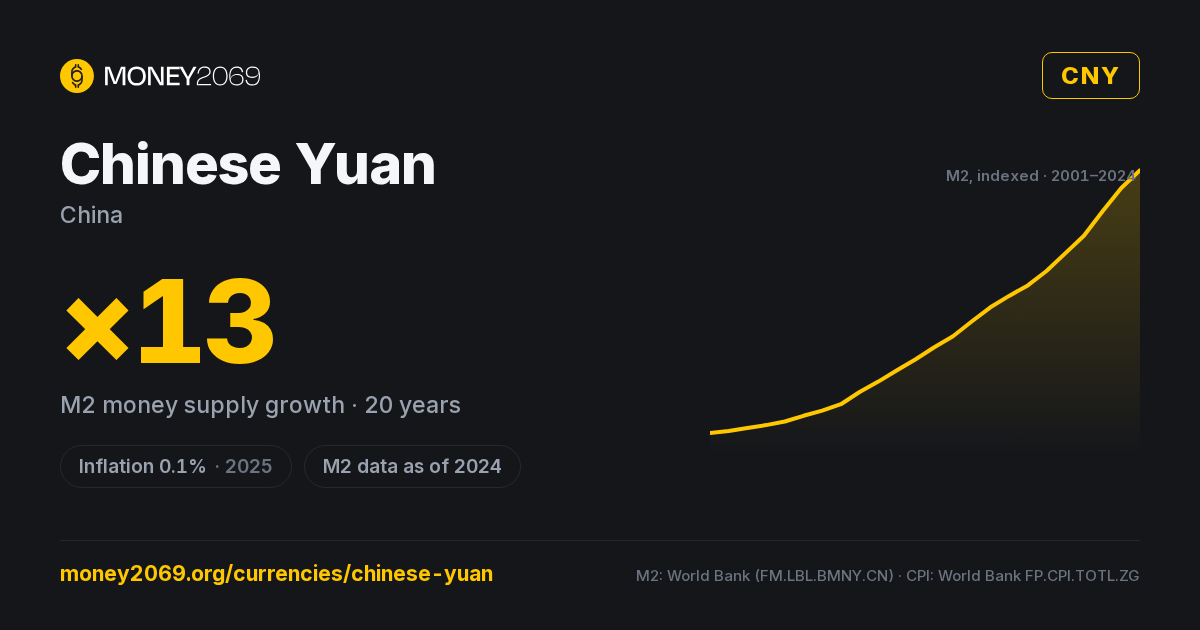
M2 money supply, indexed to 2001 = 100
Every line goes up — that’s the point. Angle of attack tells the story.
All series matched through 2024; some central-bank sources lag a year or two.
CNY highlighted against the top 10 reserve currencies — M2 broad money, indexed to 2001 = 100. CNY series: World Bank (FM.LBL.BMNY.CN), as of 2024.
Chinese Yuan M2 money supply
Broad money in CNY (cash + deposits + close substitutes), annual back to ~1960 via World Bank FM.LBL.BMNY.CN. Log scale auto-engages for hyperinflation outliers.
Chinese Yuan inflation history
Annual CPI YoY since 1987 — World Bank consumer price index for China. Inflation volatility is one of three inputs into the Money2069 sound-money score.

Purchasing power calculator
How much would your Chinese Yuan be worth today if you'd held it since…?
Calculation: cumulative product of (1 + CPI YoY) from the chosen year through 2025. Source: World Bank consumer price index (annual). Daily-refreshed.
Data sources & methodology
- FX (USD):
- Frankfurter / ECB · daily, Exchange Rate API fallback
- CPI YoY:
- World Bank FP.CPI.TOTL.ZG · annual
- M2 broad money:
- IMF / central-bank monthly · World Bank annual fallback (LCU)
- Market cap (USD):
- M2 / FX rate · daily
- 10-year M2 change:
- (M2 today / M2 10y ago) − 1
- M69 score:
- Weighted: CPI (50%), 10y M2 growth (40%), 1y FX stability (10%)
- Last fetched:
- 2026-07-28 02:00:01
- Country code (ISO 3166-1):
- CHN
Note: Managed float; CIPS settlement
Raw data: /api/v1/currencies/current/CNY · Rates by Exchange Rate API
The Chinese Yuan from a sound-money lens
Managed float; CIPS settlement; the world's largest M2 by some measures.
The Chinese yuan (renminbi) is the only major reserve currency whose central bank does not target inflation in the conventional sense. The People's Bank of China manages a daily fixing band against a basket, runs explicit capital controls, and pursues a quantity-based monetary policy that prioritises credit growth and exchange-rate stability over headline CPI.
The result has been the largest M2 expansion in modern history — from ¥10 trillion in 2000 to over ¥300 trillion today, a 30x increase. Much of that money landed in real estate, pushing residential property to roughly 70% of household wealth, and triggering the slow-motion Evergrande/Country Garden debt crisis that's still unwinding.
Officially, CPI inflation has averaged around 2% over the past decade, including bouts of outright deflation (2024). Skeptics note that the official basket understates housing and services. What's not in dispute: the monetary base has grown fast enough that the yuan has lost roughly 70% of its 2000 purchasing power against any honest CPI deflator.
Internationalisation is the wildcard. CIPS — the cross-border yuan settlement system — now handles trillions in annual flows, and bilateral trade with Russia, Brazil, and several Gulf states settles increasingly in renminbi. The yuan's path to reserve status depends on capital-account convertibility, which would mean ceding the daily fixing — a trade-off Beijing has so far declined to make.
Frequently asked questions
Who issues the Chinese Yuan?+
What is the inflation rate of the Chinese Yuan?+
Has the Chinese Yuan been debased?+
Is the Chinese Yuan sound money?+
How does the Chinese Yuan compare to gold or the US dollar?+
How often is this data updated?+
Compare with
More from Money2069
The Chinese Yuan inflates by policy. Money2069 runs on fixed rules — issuance targets 0%, purchasing power preserved by design, no central bank required.
