

British Pound
GBPOldest still-circulating currency
M2 money supply, indexed to 2001 = 100
Every line goes up — that’s the point. Angle of attack tells the story.
All series matched through 2024; some central-bank sources lag a year or two.
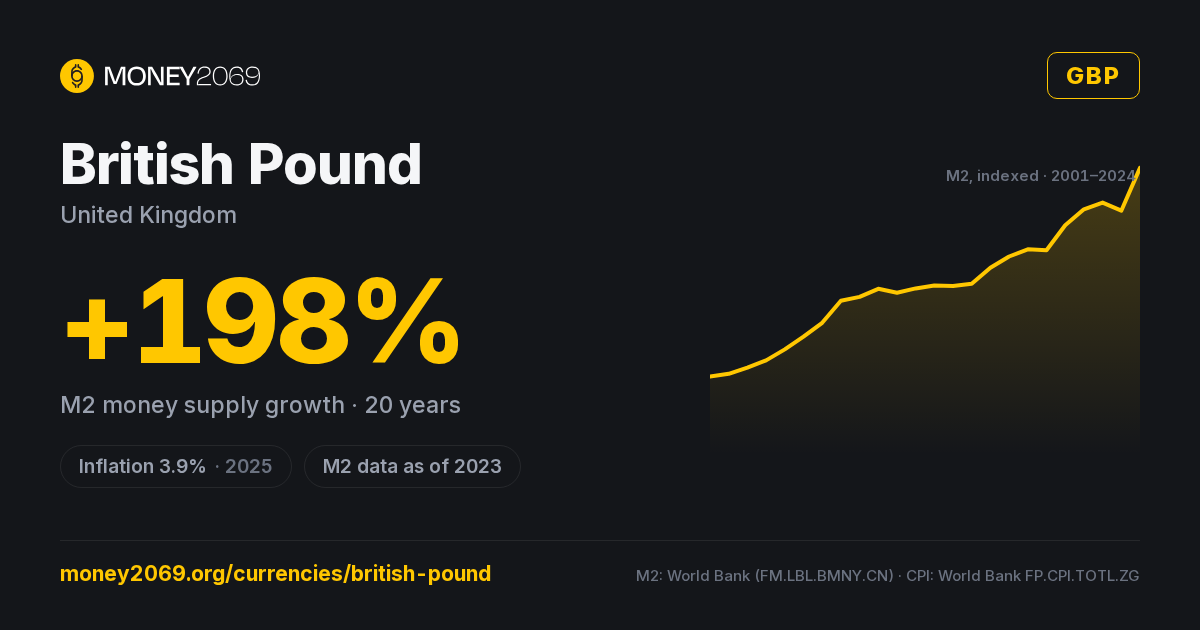
GBP highlighted against the top 10 reserve currencies — M2 broad money, indexed to 2001 = 100. GBP series: World Bank (FM.LBL.BMNY.CN), as of 2024.
British Pound M2 money supply
Broad money in GBP (cash + deposits + close substitutes), annual back to ~1960 via World Bank FM.LBL.BMNY.CN. Log scale auto-engages for hyperinflation outliers.
British Pound inflation history
Annual CPI YoY since 1966 — World Bank consumer price index for United Kingdom. Inflation volatility is one of three inputs into the Money2069 sound-money score.

Purchasing power calculator
How much would your British Pound be worth today if you'd held it since…?
Calculation: cumulative product of (1 + CPI YoY) from the chosen year through 2025. Source: World Bank consumer price index (annual). Daily-refreshed.
Data sources & methodology
- FX (USD):
- Frankfurter / ECB · daily, Exchange Rate API fallback
- CPI YoY:
- World Bank FP.CPI.TOTL.ZG · annual
- M2 broad money:
- IMF / central-bank monthly · World Bank annual fallback (LCU)
- Market cap (USD):
- M2 / FX rate · daily
- 10-year M2 change:
- (M2 today / M2 10y ago) − 1
- M69 score:
- Weighted: CPI (50%), 10y M2 growth (40%), 1y FX stability (10%)
- Last fetched:
- 2026-09-07 02:00:03
- Country code (ISO 3166-1):
- GBR
Note: Oldest still-circulating currency
Raw data: /api/v1/currencies/current/GBP · Rates by Exchange Rate API
The British Pound from a sound-money lens
Oldest still-circulating currency. Bank of England (1694) — and a 99% loss since.
The pound sterling traces its design back to 1158 and its name to Anglo-Saxon silver pennies, which makes it — at over 850 years — the world's oldest still-circulating currency. The Bank of England, founded in 1694, is the second-oldest central bank on this page. None of which has prevented the pound from losing nearly all its purchasing power over the modern monetary era.
A 1900 pound bought what about £140 buys today — a 99% loss across the century. The pace accelerated after 1971 (the abandonment of Bretton Woods) and again after 2008 (the Bank of England's first quantitative easing programme). M4 broad money roughly tripled between 2000 and 2024.
The pound's defining moment of recent years was the September 2022 mini-budget crisis: a fiscal package the gilt market rejected forced £65bn of emergency BOE bond-buying and a 7% intraday currency drop. It was a reminder that even reserve-currency status doesn't insulate a fiat from fiscal credibility shocks.
CPI inflation peaked at 11.1% in October 2022 — the highest in 41 years — before easing back to the BOE's 2% target. The structural pressures haven't gone away: an aging population, rising debt-to-GDP, and a Bank balance sheet still well above pre-crisis norms. The pound's institutional credibility (rule of law, an independent central bank, deep gilt markets) remains real. Its monetary credibility — its ability to hold value over decades — is on the same trajectory as every other fiat on this list.
Frequently asked questions
Who issues the British Pound?+
What is the inflation rate of the British Pound?+
Has the British Pound been debased?+
Is the British Pound sound money?+
How does the British Pound compare to gold or the US dollar?+
How often is this data updated?+
Compare with
More from Money2069
The British Pound inflates by policy. Money2069 runs on fixed rules — issuance targets 0%, purchasing power preserved by design, no central bank required.
