

Brazilian Real
BRLReal plan ended 1994 hyperinflation
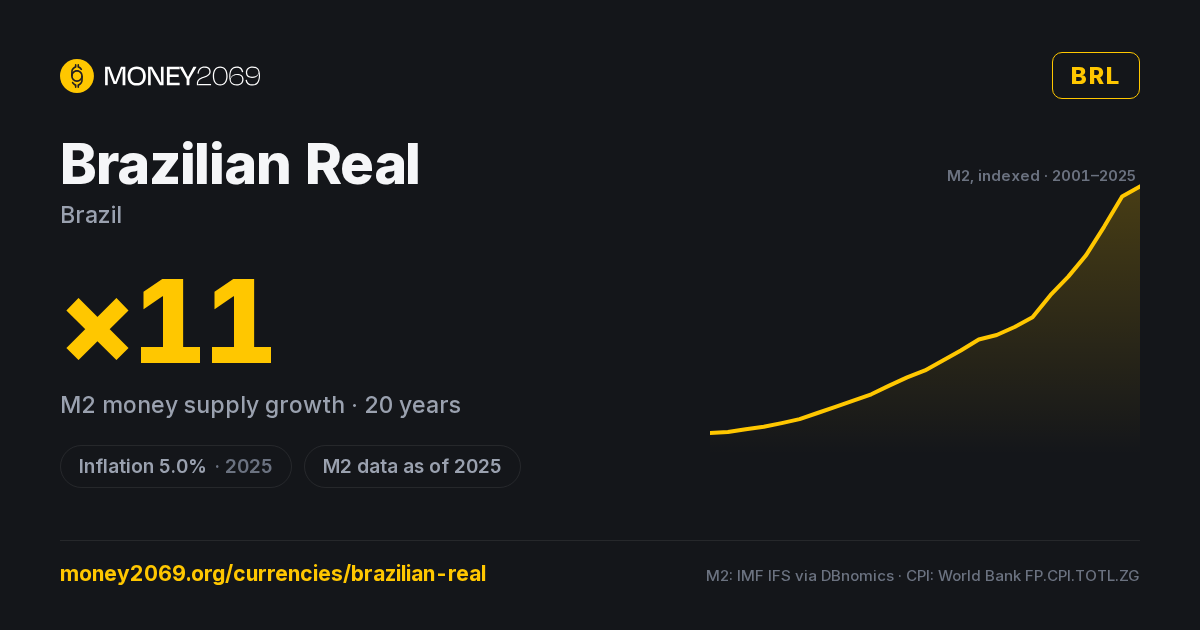
M2 money supply, indexed to 2001 = 100
Every line goes up — that’s the point. Angle of attack tells the story.
All series matched through 2024; some central-bank sources lag a year or two.
BRL highlighted against the top 10 reserve currencies — M2 broad money, indexed to 2001 = 100. BRL series: IMF IFS via DBnomics, as of 2025.
Brazilian Real M2 money supply
Broad money in BRL (cash + deposits + close substitutes), annual back to ~1960 via World Bank FM.LBL.BMNY.CN. Log scale auto-engages for hyperinflation outliers.
Brazilian Real inflation history
Annual CPI YoY since 1981 — World Bank consumer price index for Brazil. Inflation volatility is one of three inputs into the Money2069 sound-money score.

Purchasing power calculator
How much would your Brazilian Real be worth today if you'd held it since…?
Calculation: cumulative product of (1 + CPI YoY) from the chosen year through 2025. Source: World Bank consumer price index (annual). Daily-refreshed.
Data sources & methodology
- FX (USD):
- Frankfurter / ECB · daily, Exchange Rate API fallback
- CPI YoY:
- World Bank FP.CPI.TOTL.ZG · annual
- M2 broad money:
- IMF / central-bank monthly · World Bank annual fallback (LCU)
- Market cap (USD):
- M2 / FX rate · daily
- 10-year M2 change:
- (M2 today / M2 10y ago) − 1
- M69 score:
- Weighted: CPI (50%), 10y M2 growth (40%), 1y FX stability (10%)
- Last fetched:
- 2026-09-07 02:00:20
- Country code (ISO 3166-1):
- BRA
Note: Real plan ended 1994 hyperinflation
Raw data: /api/v1/currencies/current/BRL · Rates by Exchange Rate API
The Brazilian Real from a sound-money lens
Real plan ended 1994 hyperinflation. Current inflation: politely controlled chaos.
The Brazilian real is a currency with institutional memory of hyperinflation. The 1980s and early 1990s saw inflation routinely above 1,000% YoY — at peak, Brazil printed cruzeiros, cruzados, novos cruzados, and cruzeiros again before the 1994 Plano Real finally broke the pattern with a new currency, fiscal reforms, and an inflation-targeting framework.
The thirty years since the real's 1994 launch have been comparatively calm — but only by Brazilian standards. Inflation has averaged roughly 6-7% per year, the central bank's target has drifted upward over time, and the BRL has fallen from roughly 1:1 with the dollar in 1994 to over 5:1 today. M3 broad money has grown roughly 15x in nominal terms over the same window.
The Banco Central do Brasil targets 3% +/- 1.5% CPI inflation. It has been one of the more aggressive central banks globally — Brazil's Selic rate hit 13.75% in 2022, well ahead of US/EU equivalents — which has helped contain the worst of post-pandemic inflation. The trade-off is some of the highest real interest rates in the world, which weighs on growth and the housing market alike.
Brazil's vulnerability is fiscal: gross debt is over 80% of GDP, the cost of servicing it exceeds 7% of GDP annually, and political cycles regularly produce expansionary budgets that test the central bank's independence. Each test has been narrowly survived. The BRL is, by emerging-market standards, a credible currency. By G10 standards, it remains a high-yield, high-volatility play on Brazilian institutional resilience.
BRL 100 in 1995 buys roughly BRL 19 of comparable goods today.
Frequently asked questions
Who issues the Brazilian Real?+
What is the inflation rate of the Brazilian Real?+
Has the Brazilian Real been debased?+
Is the Brazilian Real sound money?+
How does the Brazilian Real compare to gold or the US dollar?+
How often is this data updated?+
Compare with
More from Money2069
The Brazilian Real inflates by policy. Money2069 runs on fixed rules — issuance targets 0%, purchasing power preserved by design, no central bank required.
